
Factory-Welded Modules: How Sealed, Watertight Welds Are Built
GUIDE SERIES · PART 31 OF 48
Factory-Welded Modules: How Sealed, Watertight Welds Are Built
What makes a weld watertight, why a factory line gives the best conditions for it, and what that means for a TOPK module.
In a steel building, watertightness is largely a matter of welds. A seam that is continuous and sound keeps water out for decades. A seam with tiny holes, gaps or cracks lets it in, slowly and out of sight. Welds are also where used-container conversions most often go wrong, as Part 30 of this series explains. This guide looks at the other side: what makes a weld watertight, why an industrial line is the best place to make one, and what it means for a TOPK module.
What a weld has to do
In a steel module, every structural weld has three jobs.
| Job | What it means |
|---|---|
| Carry load | Join the frame and panels so the box works as one structure |
| Seal | Form a continuous barrier, so rain and moisture cannot pass through the seam |
| Last | Stay sound for decades, with a coating that protects it from rust |
A weld that carries load but has pinholes will not seal. A weld that seals but is not protected by its coating will rust. All three have to be right.
What makes a weld watertight
Welding specialists agree on the main points.
- A clean joint. The steel at the joint should be bare and bright, with no rust, oil, grease, moisture or paint. Contaminants release gas as they burn, and that gas is trapped in the weld as tiny voids called porosity.
- Good gas shielding. The molten weld is protected from the air by a shielding gas. Too little gas, too much, a draught across the weld, or a leak in the gas line lets air in and causes porosity.
- The right heat and speed. Too hot burns through thin steel and distorts it. Too cold fails to fuse the metal. Travel speed and current have to match the thickness.
- A good fit. The parts should meet cleanly with a small, even gap, so the weld can fill the joint without bridging a big space.
- A continuous seam. Where a joint must be watertight, the weld must run without breaks, and the start and stop of each pass must be sound.
- No defects. Cracks, undercut, lack of fusion and porosity all open a path for water.
- A restored coating. The coating burned off by the weld is replaced, so the steel is protected.
- Checks. The welds are inspected, in stages, not only at the end.
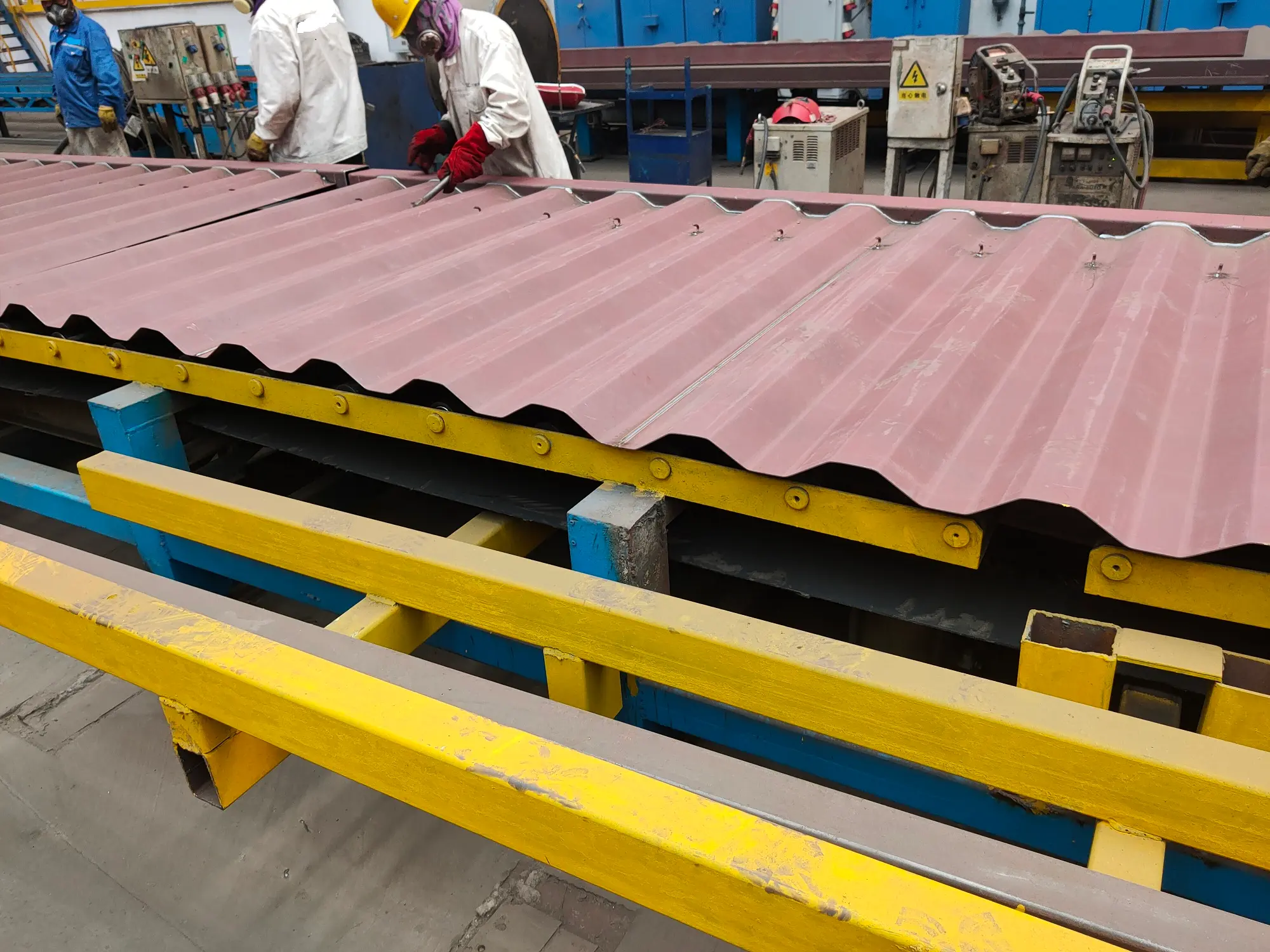
Weld defects that let water in
| Defect | Typical cause | Why it matters for water |
|---|---|---|
| Porosity | Paint, rust, oil, moisture, or poor gas shielding | Pinholes and hidden voids can connect and let water pass through the seam |
| Lack of fusion | Heat too low, speed too fast, dirty or badly fitted joint | The weld sits on the steel without bonding, leaving a channel |
| Undercut | Heat too high or speed wrong | A groove along the weld edge that weakens it and traps water |
| Cracks | Stress, contamination, rapid cooling | A direct path for water, and a weak point |
| Holes at the ends of welds | Poor stopping technique | A small gap at exactly the place a seam must be sealed |
| Burn-through | Too much heat on thin steel | A hole in the wall |
Many of these defects trace back to the same cause: contamination on the steel, or conditions at the weld that the welder cannot control.
40-Foot Container Homes
Why a factory line gives the best conditions
| Condition | On an industrial line | In a conversion workshop or on site |
|---|---|---|
| Steel | New, with clean surfaces | Used, painted and weathered |
| Surface preparation | Part of the process, done to the same standard each time | Done by hand, and easy to rush on ribbed walls |
| Environment | Indoors, out of the rain and the wind | Often in a yard or on site, with draughts and damp |
| Gas shielding | Stable coverage, because there are no draughts | Easily disturbed by wind |
| Holding the parts | Jigs and fixtures hold them in place, so joints fit consistently | Parts held by hand and clamps |
| Welding position | Parts arranged so the welder works in the best position | Often awkward positions on a finished box |
| Procedure | A set procedure, repeated | Varies with each welder and each box |
| Checks | At stages along the line | Usually at the end, if at all |
| Coating | Applied after welding, in a planned sequence | Patched after the weld |
None of these are tricks. They are the ordinary advantages of making the same thing again and again, in good conditions, with new materials.

How welds are checked
Industry practice has several methods, and a good factory uses a mix.
- Visual inspection. Surface pores, pits, undercut and gaps can often be seen in good light, especially at the start and stop of each weld.
- Dye penetrant testing. A dye is applied and drawn into any crack or pore that breaks the surface, and a developer shows where.
- Water testing. Water is sprayed on a finished seam or opening to find leaks before it is closed up.
- Other methods, such as ultrasonic or radiographic testing, find defects below the surface where the work needs it.
How a TOPK module is made
TOPK modules are made of new steel, welded on an industrial line. The welds are designed to be sealed and watertight. Door and window openings are made to your requirements as part of the structure, with the frame around each one built in, so no finished wall has to be cut and patched afterwards. The insulation, 75 mm of polyurethane foam on all six faces, is applied in the factory as a continuous layer. TOPK builds two kinds of module, both made to your drawings: container-size modules, which look like shipping containers and carry a CSC plate, and non-standard size modules. Both are new.
If you would like to know how the welds and checks work on your project, ask us, and we will tell you.
Joining modules without welding on site
When a building is made of several modules, TOPK joins them with our own quick-connection system, without welding between the modules. That means no welding on your site, so no site weld to go wrong, and no burnt coating at the joint. The connection is designed to be waterproof and to keep the insulation continuous across the joint. Some interior and exterior trim at the joint line is finished on site.

A watertight building is the sum of its details
Sealed welds are the foundation, and they are not the whole story. Windows, doors, roof penetrations, flashings, gutters and the joints at the trims also have to be done properly, and most of those are fitted locally by your own trades. Our drawings mark where each opening and service route goes, and good installation by your windows supplier and contractor completes the job. Part 29 of this series explains the other design differences between a cargo box and a building.
Used-container conversion and factory module compared
| Feature | Used container, openings cut afterwards | TOPK module |
|---|---|---|
| Steel | Used, painted, weathered | New |
| Where welds are made | In a workshop or on site, on coated steel | On an industrial line, on new steel |
| Openings | Cut after the box is finished, then reinforced | Made as part of the structure |
| Seam quality | Depends on each welder and each wall | Designed to be sealed and watertight |
| Insulation around openings | Retrofitted | Applied in the factory, continuous |
| Cost | Part 28 of this series adds it up | Quoted at a fixed scope |
Common mistakes
- Judging a weld by how it looks from outside. A weld can look neat and still have hidden voids.
- Welding over paint or rust. The steel must be clean.
- Rushing the finish at the end of a seam. Starts and stops are where holes appear.
- Skipping the water test. Test before the wall is closed.
- Forgetting the details beyond the welds. Windows, flashings and sealants matter as much.
FAQ
Why do welds leak?
Usually because of pinholes or voids caused by contamination such as rust, paint, oil or moisture, or by poor gas shielding, or because of cracks, lack of fusion or gaps. They are often hidden inside the wall.
Why is a factory line better for welding than a site or workshop?
The steel is new and clean, the environment is controlled, parts are held in fixtures, the procedure is repeated, and welds are checked in stages.
How are TOPK’s welds watertight?
They are made on an industrial line, on new steel, and designed to be sealed and watertight. The openings are part of the structure, and the insulation is continuous. Ask us how this works on your project.
Is there welding on site when modules are joined?
No. TOPK modules are joined with our own quick-connection system, without welding between modules.
Do I pay in advance?
Yes. Every TOPK building is custom made, so payment in full by T/T is received before production begins.
Start with your drawings
Send us your drawings or a sketch, with the doors and windows you want, and the destination port. We will prepare production drawings and quote the module.