
Modular Building Container Size: How to Design for 20ft and 40ft Shipping
GUIDE SERIES · PART 05 OF 48
Modular Building Container Size: How to Design for 20ft and 40ft Shipping
Size and split modules to fit 20 ft, 40 ft and 40 ft high-cube containers and keep freight costs down
Shipping is one of the largest costs of an imported building, and the biggest factor you control is module size. A module that fits inside a 20 ft container, a 40 ft standard container or a 40 ft high-cube container ships at container rates. One that does not fit can go by flat-rack container or by breakbulk vessel, depending on the actual situation, and the freight cost is much higher. This guide shows how to design for the container from the start, how to split a larger building into modules, and what to tell TOPK so that we can confirm the sizes before production.
Why module size decides the freight cost
Container freight is sold by the box. The route is served by regular sailings, and the price depends mainly on the number and size of the containers. Oversized cargo can require special equipment, additional handling or a different shipping service, which usually costs more.
Designing each module around a container keeps the whole shipment on the economical route. It also keeps the number of containers predictable, which makes the budget easier to plan.
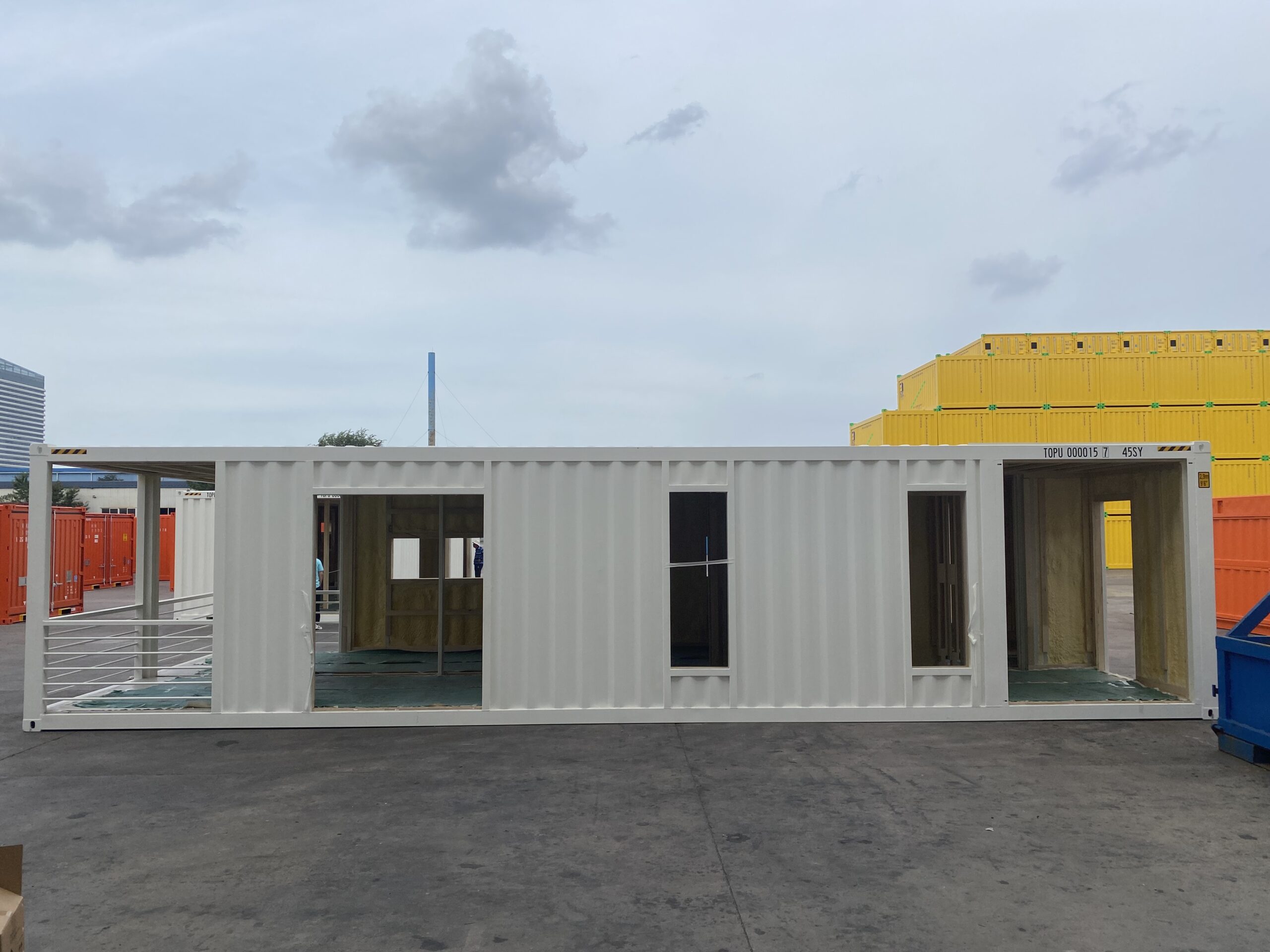
Two ways to design around the container
| Feature | Non-standard size module | Container-size module |
|---|---|---|
| Size | Built to your drawings, sized to fit inside a container | Same as a standard shipping container |
| Appearance | Designed to your brief | Similar to a shipping container |
| CSC plate and classification society certification | No CSC plate | Yes |
| How it ships | Loaded inside a container | As a container |
| Best when | The layout needs freedom of shape or finish | A container look suits the project and you want the most predictable shipping |
Both routes ship at container rates. The first gives more design freedom. The second is the most direct.
20ft Container Home Module
The three container sizes
The figures below are typical. Exact dimensions vary by container and carrier, so TOPK confirms them for your shipment before the modules are built.
Inside dimensions
These are the limits for non-standard modules loaded inside a container. Loading clearance must also be allowed.
| Container | Inside length | Inside width | Inside height | Door opening (width × height) |
|---|---|---|---|---|
| 20 ft container | About 5.9 m | About 2.35 m | About 2.39 m | About 2.34 m × 2.28 m |
| 40 ft standard | About 12.0 m | About 2.35 m | About 2.39 m | About 2.34 m × 2.28 m |
| 40 ft high-cube | About 12.0 m | About 2.35 m | About 2.69 m | About 2.34 m × 2.58 m |
Outside dimensions
These are the dimensions that container-size modules match.
| Container | Outside length | Outside width | Outside height |
|---|---|---|---|
| 20 ft container | About 6.06 m | About 2.44 m | About 2.59 m |
| 40 ft standard | About 12.19 m | About 2.44 m | About 2.59 m |
| 40 ft high-cube | About 12.19 m | About 2.44 m | About 2.90 m |
For planning, the footprint of one 20 ft container-size module is roughly 15 m², and one 40 ft module roughly 30 m². The 40 ft high-cube has the same footprint as the standard 40 ft, with about 30 cm more height. Modules loaded inside containers have smaller footprints.

Six rules for designing around a container
- Design to the door opening, not only the inside size. Modules are loaded through the door end, so the opening limits the width and height of the module as much as the inside of the container does. Leave clearance so that the module can be loaded safely. TOPK confirms the clearance for each shipment.
- Remember what the wall build-up takes away. A module sized to fit inside a container has an outside width of about 2.3 m at most, subject to loading clearance. After the thickness of the walls and insulation, the clear width of the room inside is noticeably narrower than the container itself. Plan room widths with this in mind.
- Choose the high-cube when you need height. The extra 30 cm suits taller ceilings and thicker floor and roof build-ups, for example where more insulation is required by your local code.
- Think in lengths of 6 m and 12 m. A container-size 20 ft module is about 6 m long and a 40 ft module about 12 m. Modules loaded inside containers must be shorter to allow clearance. Layouts that account for these limits use the container well.
- Put the joints where the rooms divide. When a building is made from several modules, plan the joints at natural boundaries such as walls between rooms. The joint line is then less visible, the trim is simpler, and services cross it in fewer places.
- Keep weight in mind. A module has to be lifted onto a truck, and again onto the foundation. Tell us about any weight or crane limits at your site.
40ft Container Home Module
Splitting a larger building into modules
Many buildings are bigger than one container. They are made by joining several modules on site. TOPK modules connect with our own quick-connection system, without welding between the modules. The connection is designed to be waterproof, to keep the insulation continuous across the joint, and to be quick to install. As an illustration, two 40 ft modules joined side by side give a footprint of roughly 60 m².
The steps are straightforward:
- Start with your layout and the overall footprint you want.
- Divide it along walls or room boundaries into parts that each fit one container size.
- Decide how the parts connect, side by side or end to end, as your drawings and local code allow.
- Plan the joints and how services cross them. Your local installers connect plumbing and wiring across the joints on site, using certified products.
- Send the drawings to TOPK. We confirm that every module fits its container and quote the whole building.
Some interior and exterior trim at each joint line is still finished on site, so allow time and budget for it. If you may need to move the building later, tell us at the start. Under the right conditions, TOPK modules can be separated quickly and transported to a new site.

Common mistakes
- Designing the building first and the container second. A layout that is a few centimetres too wide or too high can require a more expensive shipping method.
- Forgetting that the door opening is smaller than the inside. The module has to pass through it.
- Ignoring the wall thickness. A room that looks wide enough on the outside plan may be narrower inside than expected.
- Splitting the building in awkward places. Joints through the middle of a room are harder to finish and harder to hide.
- Changing the size after the drawings are approved. Each building is custom made, so changes after final approval affect the schedule and the cost.
FAQ
How much does it save if my module fits inside a container?
Container freight is priced per container, and shipping by flat-rack container or breakbulk is considerably higher, so the saving can be large. The amount depends on the route and the season, so we quote it for your project.
Which container should I design for?
The 20 ft container suits small units. The 40 ft standard suits long single modules. The 40 ft high-cube suits modules that need extra height. Tell us your layout and we will recommend one.
Can a very large building ship in containers?
Almost always, by dividing it into modules that each fit. If a single oversized module is essential, it can go by flat-rack container or breakbulk vessel, depending on the situation, and we will explain the cost before you decide.
Do container-size modules limit the design?
They follow the size and look of a standard container, so the outer shape is fixed. The interior layout, openings and finishes are still designed to your brief.
How are the modules joined on site?
With TOPK’s own quick-connection system, without welding between the modules. It is designed to be waterproof, to keep the insulation continuous and to be quick to install. Your local installers connect the services across the joints using certified products.
Compare Modular Container Building Options
Type your paragraph here