Exploration Camp Accommodation: Modular Options for Geology Teams
GUIDE SERIES · PART 19 OF 48
Exploration Camp Accommodation: Modular Options for Geology Teams
Camp layouts, comfort, transport to remote sites and relocation, built from custom TOPK steel-structure modules.
An exploration team works far from town, often for a season or two, and then moves on. The camp has to be comfortable enough that people sleep well and stay productive, tough enough to survive the weather and the journey, and light enough on the land that it can be removed afterwards.
This guide looks at how a modular camp can meet those aims, what a camp needs, how modules are moved to a remote site, and what TOPK supplies.
It is a general guide. Please confirm what applies at your site with the regulators that cover it.
What an Exploration Camp Needs
| Function | What It Provides |
|---|---|
| Sleeping | Rooms where people rest, with enough quiet, ventilation and temperature control |
| Dining and kitchen | Safe food preparation and a place to eat together |
| Ablutions | Showers, toilets and laundry, with water and waste handled properly |
| Office and briefing | A place for planning, data and meetings |
| Core logging and sample handling | Space for logging, cutting and storing samples, where the work needs it |
| Storage | Dry storage for equipment, parts and supplies |
| Power | A reliable supply, often a mix of solar, batteries and a generator |
| Water and wastewater | Safe supply and treatment or disposal |
| Fuel and waste | Safe storage and a route out |
| Communications and first aid | Contact with the outside world and an emergency plan |
Why Modular Suits a Camp
- Made for the job. Each module is made to order, so rooms, kitchens and offices fit the team and the work.
- Built in a factory. Quality is controlled before the modules leave, and there is much less building to do at a remote site.
- Quick on site. Modules are lifted into place and connected, so the camp is ready sooner.
- Flexible. Add modules when the team grows, take them away when it shrinks.
- Movable. The camp can follow the work.
The Module Types
TOPK builds two kinds of module, both made to your drawings.
| Feature | Container-Size Module | Non-Standard Size Module |
|---|---|---|
| Dimensions | Same as a standard 20 ft or 40 ft container | Built to your drawings |
| Appearance | Similar to a shipping container | Designed to your brief |
| CSC plate | Yes | No |
| How it ships | As a container | Inside a container if it fits; flat-rack container or breakbulk vessel if it does not |
For planning, one 20 ft module has an outside footprint of about 15 m², and one 40 ft module about 30 m². As an illustration of how modules can serve a camp:
| Camp Function | Typical Module |
|---|---|
| Sleeping | One 40 ft module divided into several single rooms with a shared corridor, or 20 ft modules for smaller groups |
| Dining and lounge | One or two 40 ft modules joined side by side |
| Kitchen | A 40 ft module, planned with your kitchen equipment, next to the dining module |
| Ablutions | A 20 ft or 40 ft module with showers, toilets and laundry |
| Office and briefing | A 20 ft or 40 ft module |
| Core logging or sample store | A 40 ft module, or more, depending on the work |
| Energy | A separate module for solar, batteries and a generator |
The exact number of rooms and the layout come from your drawings and your local rules.
Modules sized to fit inside a container, or matching a container, ship at container rates and give the best value for money. A 40 ft high-cube container gives about 30 cm more height than a standard container, which helps with ventilation and a comfortable room.
Comfort for People Who Work Hard
40ft Modular Accommodation Units
A good camp pays back through rest and morale. Think about:
- Sleeping rooms. Single rooms where the work allows, with a proper bed, storage, a window and a door that locks. Noise from generators and machinery should be kept away from sleeping modules.
- Temperature. The insulation level comes from your climate and local requirements, and we build to the figures on your approved drawings. Heating, cooling and ventilation are chosen locally, sized for the climate. In cold or hot regions, tell us the temperature range at the start.
- Condensation and dust. A well-sealed, well-insulated module reduces condensation, and sealed joints keep dust out. We check the thickness, joints and the junctions with openings during production.
- Ablutions. Plan enough showers and toilets for the team, with good ventilation, hot water and surfaces that clean easily.
- Dining and lounge. A place to eat well and relax matters a great deal on a long rotation.
- Light and views. Windows help. Openings are built to your drawings, and windows and doors are supplied and fitted locally.
Built for the Journey and the Weather
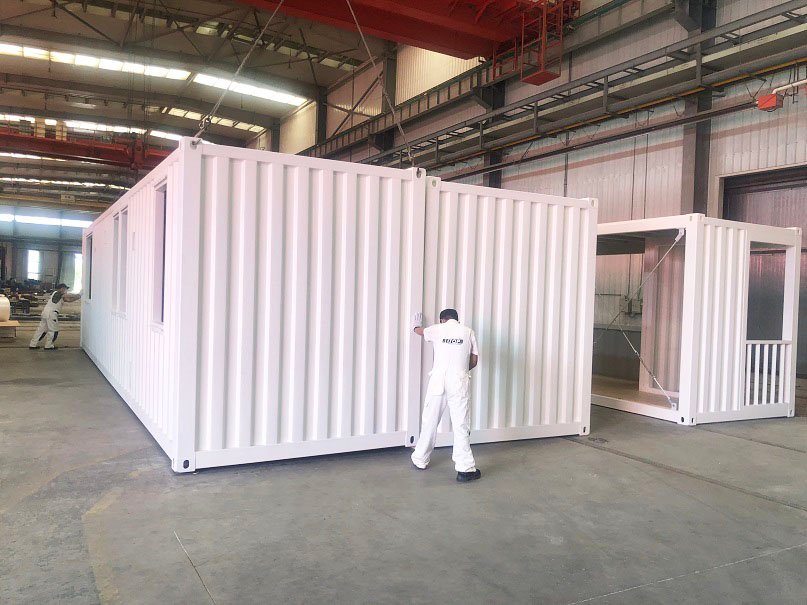
- Steel structure. The module is a steel frame, designed for lifting, road transport and the loads at your site, such as wind and snow. Your engineer provides the design loads, and TOPK builds to the approved drawings.
- Corrosion protection. The coating should cover edges, corners and joints. Tell us about coastal, humid or very dry conditions.
- Sealed envelope. Doors, windows and joints are designed to keep out rain, dust and pests.
- Lifting. A module can be lifted as a single unit. Check the lifting equipment available at your site.
Getting Modules to a Remote Site
Transport to a remote exploration site is often the hardest part. Plan it early.
- From the factory to your port. Modules sized for a container ship at container rates. A module too large for a container can go by flat-rack container or breakbulk vessel, and which one suits depends on the actual situation. Modules that match standard container sizes cost less to ship and give the best value for money.
- From the port to the site. Check the roads, bridges, river crossings and any seasonal closures. Check the width, height and weight a truck can carry on your route.
- The last leg. Some sites have only a track, a barge or an airstrip. Tell us the limits on size and weight for the final journey, so that we size the modules to suit. Smaller modules can make an awkward site possible.
- Lifting at the site. Plan where the crane or loader stands and where each module goes.
- Season. Wet or frozen conditions can open or close a route. Plan the delivery for a season when the route is passable.

Light on the Land
Exploration permits often ask that a camp is removed, and the site restored, when the work ends. Modules help.
- Small footprint. Modules can stand on pads, piers, skids or ground screws, chosen with your engineer to suit the ground and the rules, instead of a large poured slab.
- Removable. Modules are connected without welding, so they can be separated and taken away.
- Reusable. The camp can be re-erected at the next site.
Joined Modules, and Moving the Camp
When modules are joined, TOPK uses our own quick-connection system, without welding between modules. The connection is designed to be waterproof, to keep the insulation continuous across the joint and to be quick to install. Some interior and exterior trim at the joint line is finished on site.
Because there is no welding between modules, a camp can be taken apart and moved. Under the right conditions, TOPK modules can be separated quickly and transported to a new site, so the camp can follow the drill targets.
This depends on the design, the foundations and the route, so tell us at the start if you expect to move the camp, and we will plan the connections and the layout with that in mind.
Power, Water and Waste
A camp needs services, and they are usually the biggest planning item.
- Power. Many camps use solar panels and batteries, with a generator as backup. Parts 18 and 19 of this series explain how an energy module works and how it compares with a diesel generator.
- Water. Plan the source, treatment, storage and quality testing for drinking and washing water.
- Wastewater. Plan treatment or removal, according to your permits.
- Waste and fuel. Plan safe storage and the route out.
TOPK builds the modules and prepares the openings and service routes in them. The services themselves are designed and installed by your specialists.
Approvals
Camp approval varies widely. Exploration camps are often covered by the exploration permit and its conditions, by environmental rules, and by rules on land access, water, wastewater and waste.
Accommodation may also have rules on fire safety, health and safety at work, and food safety. A camp that is temporary may be treated differently from one that is permanent.
Speak to the regulator that covers your exploration licence, and to your local authority, before you finalise the layout. Your local professionals prepare the documents your authority requires, and TOPK builds to the approved drawings.
The CSC plate and classification society certificate on container-size modules relate to shipping only. They do not replace any approval.
Multi-Story Modular Staff Housing
What TOPK Supplies, and What You Arrange Locally
TOPK builds the module: the steel structure, insulation, and the wall, floor and roof system, with the openings and service routes set out in your drawings.
For small orders, plumbing, wiring, windows, doors, kitchen equipment and interior fit-out are chosen and fitted in your own country, using products that carry your national certification.
You also arrange the foundations, transport to site, crane or loader, services, and the approvals and inspections your authority requires.
For larger camps, TOPK can supply fully finished buildings with certified components. Tell us your quantity, your market and your specification, and we will confirm what we can offer.
The Process, Step by Step
- Brief. Tell us the team size, the length of the work, the climate and the site access.
- Camp plan. Choose the modules and the layout, with your project manager.
- Send drawings or a sketch to TOPK. Include the lifting and transport limits for your site. We prepare production drawings and size the modules for shipping and for the last leg.
- Approvals. Your local professionals prepare the documents your authority requires.
- Order and pay. Every TOPK building is made to order and cannot be sold to anyone else. Production starts only after the final drawings are approved and payment in full is received by T/T.
- Production and shipping. We send photos at the main stages. Plan the delivery for a season when your route is passable.
- Installation. Modules are lifted onto the prepared foundations and joined with the quick-connection system.
- Fit-out and handover. Your trades connect the services and finish the modules, and your authority inspects them.
Common Mistakes
- Planning the camp before the route. The route may limit module size and weight.
- Ignoring the season. A wet or frozen route can delay delivery for months.
- Putting generators next to sleeping rooms. Keep noise and fumes away from rest.
- Underestimating water and waste. Permits often depend on these.
- Forgetting removal at the end. Plan for the camp to come apart, from the start.
- Changing the design after production starts. Each module is custom made, so changes after the final drawings are approved affect the schedule and cost.
FAQ
Can TOPK build exploration camp modules to my layout?
Yes. Every TOPK building is made to order from your drawings. If you only have a sketch, we prepare production drawings from it.
Can the camp be moved when the drilling moves?
In the right conditions, the modules can be separated quickly and transported. Tell us at the start so that we can plan the layout and the foundations for it.
What if my site has only a track or an airstrip?
Tell us the size and weight limits for the last leg. Smaller modules can make it possible.
Do you supply beds, kitchens and generators?
For most orders, the interior fit-out is chosen and fitted locally, and power equipment comes from your supplier. For larger camps, TOPK can supply fully finished buildings with certified components. Contact us with your quantity and market.
Can modules work in very cold or very hot climates?
We build the wall, floor and roof system to the insulation figures on your approved drawings. Tell us the temperature range and your local requirements.
Do I pay in advance?
Yes. Every TOPK building is custom made, so payment in full by T/T is received before production begins.
Request a Quote for Exploration Camp Accommodation