
Modular Container Home Cost: What You Really Pay, from Modules to Move-In
GUIDE SERIES · PART 09 OF 48
Modular Container Home Cost: What You Really Pay, from Modules to Move-In
Module price, shipping, import charges, site works and local fit-out: how to budget a custom container home.
There is no single price for a modular container home, and a number without context is not much use. A home made to order from your drawings costs what its size, structure, insulation, finishes and shipping method add up to, plus the work you arrange in your own country. This guide explains what drives each part of the cost, so you can budget the whole project and give TOPK the information we need for an accurate quote.
The total cost has two halves
| Cost category | What it covers | Who handles it |
|---|---|---|
| Module cost and shipping | The modules themselves, packing and loading, and transport to your port | TOPK, and the freight forwarder |
| Landed and local cost | Import charges, delivery to site, foundations, installation, certified fit-out, permits and inspections | You and your local contractors |
When you compare projects or plan a budget, include both halves. The module price is the part TOPK quotes. The rest depends on your country, your site and your local suppliers.

What drives the module price
TOPK builds every home to order, so there is no fixed price per square metre. These are the factors that move the quote:
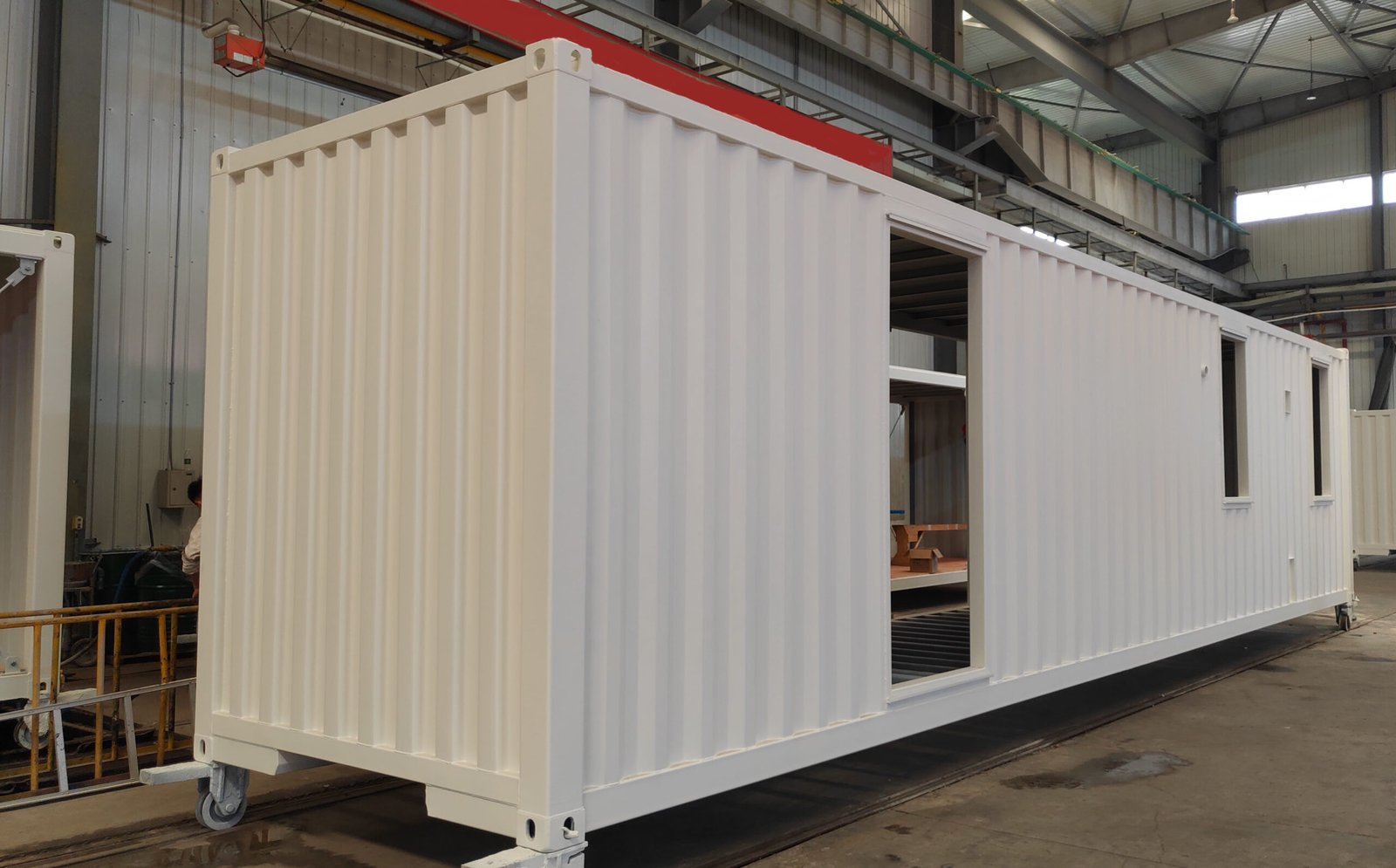
Single 40ft Container Home Specifications
| Factor | How it affects the price |
|---|---|
| Total floor area and number of modules | More area means more steel, insulation and cladding |
| Module type | Container-size modules and non-standard modules are built differently and ship differently |
| Structural loads | Snow, wind and seismic requirements set the steel sizes and connections |
| Climate and insulation level | Colder or hotter climates call for thicker or better insulation and a more detailed wall build-up |
| Cladding and finishes | The materials and the finish you choose for the outside and inside |
| Openings | The number and size of openings and the structure around them |
| Complexity of the design | Unusual shapes, many joints and special details take more production time |
| Connections between modules | TOPK’s quick-connection system joins modules without welding, and it is part of the module specification |
| Certification | Container-size modules carry a CSC plate and a classification society certificate |
Shipping cost depends on module size
Shipping is often the largest single cost after the modules themselves. Module size decides how a module ships, and that decides the price.
| Module | How it ships | Cost position |
|---|---|---|
| Container-size module (CSC plate) | As a container | Container freight rates, the most predictable |
| Non-standard module sized to fit inside a container | Loaded inside a 20 ft, 40 ft or 40 ft high-cube container | Container freight rates |
| Non-standard module too large for a container | Flat-rack container or breakbulk vessel, depending on the actual situation | Higher; the method is chosen case by case |
Modules that match standard container sizes ship at the lowest cost and give the best value for money. This is why we suggest sizing the building around the container wherever your design allows. If your design needs a larger module, we explain the shipping options and the cost before you decide.
Other things that move the freight price are the number of containers, the route, the ports, the season and the shipping term you choose (FOB, CIF or DAP).

Costs outside the module price
Plan for these lines in your own budget:
| Cost item | Handled by | Notes |
|---|---|---|
| Ocean freight and insurance | Freight forwarder | Depends on the Incoterm in the contract |
| Duty and import tax | Customs authority | Your broker confirms the tariff code and current rates |
| Customs broker and port fees | Your broker | Varies by port |
| Inland transport and crane | Local haulier and crane firm | Check road limits and site access |
| Foundations and site works | Local contractor | Depends on ground conditions |
| Utility connections | Local electrician, plumber and utility company | Water, power and drainage connections to your site |
| Certified fit-out: plumbing, wiring, windows, doors, appliances | Your local suppliers and installers | Products that carry your national certification |
| Trim and finishing at the joint lines | Local contractor | Needed inside and out where modules are joined |
| Outdoor structures | Local contractor | Decks, porches and carports |
| Permits, drawings stamped locally and inspection fees | Local authority and local professionals | Depend on the use, size and location |
For large projects, TOPK can supply fully finished buildings with certified components, so that more of the fit-out is included in one quote. Tell us your quantity and market.
Compare Shell-Only and Interior-Finished Modular Homes
How to keep the cost under control
- Design around the container. A layout a few centimetres too wide can move the whole shipment from container freight to a more expensive method.
- Repeat modules where you can. Identical modules are simpler to produce and plan.
- Plan the joints. Put them at room boundaries, so there are fewer places for services to cross and less trim to finish on site.
- Settle the design before production. Each home is custom made, so changes after the final drawings are approved affect the schedule and the cost.
- Line up your local suppliers early. Certified products and a licensed installer, ready when the modules arrive, keep the fit-out on schedule.
- Check the site. Access for a truck and crane, ground conditions and the distance to utilities can change the site budget as much as the building does.
- Tell us if you may relocate. TOPK modules are connected without welding, and under the right conditions they can be separated quickly and transported. Planning for this at the start affects the foundations and connections.
How to get an accurate quote
Send us:
- Drawings or a sketch, with the intended use.
- The overall size or number of rooms.
- The site location and climate, and snow, wind and seismic conditions if you know them.
- The appearance you want, including cladding and finishes.
- Your destination port and the shipping term you prefer.
- The quantity, if you plan more than one home.
TOPK quotes the module to a written specification that states what is included and what your local contractors supply. Every TOPK order is paid in full by T/T before production begins, so please plan your payment schedule with that in mind.
FAQ
How much does a modular container home cost?
It depends on the size, the structure, the insulation, the finishes and the shipping method. Because every home is made to order, we quote each project after we have your drawings or sketch and your site details.
Why is there no price per square metre?
Each building is custom made, and the price depends on factors such as loads, climate and finishes that differ from project to project. A figure per square metre would be misleading.
What is the biggest cost besides the modules?
Usually shipping and the work on your site. Shipping depends on module size and method. Site costs depend on your ground, access and local fit-out.
Does a container-size module cost less to ship?
Container-size modules ship as containers, so the freight is the most predictable. Non-standard modules sized to fit inside a container ship at container rates too. A module too large for a container goes by flat-rack container or breakbulk vessel, which costs more.
Is the plumbing, wiring and appliances cost included?
For most orders, these are fitted in your country with locally certified products, so they are outside the module price. For large projects, TOPK can supply fully finished buildings.
Do you need payment in advance?
Yes. Every TOPK building is custom made, so payment in full by T/T is received before production begins.
Are the modules welded together on site?
No. TOPK modules are joined with our own quick-connection system, without welding between modules. The connection is designed to be waterproof, to keep the insulation continuous and to be quick to install.